Post content
The terms KPO and BPO are used everywhere in outsourcing, and they are often mixed up. Both mean handing work to an outside team, but the kind of work is very different. Understanding KPO vs BPO helps you choose the right partner and avoid paying for the wrong service.
What is BPO?
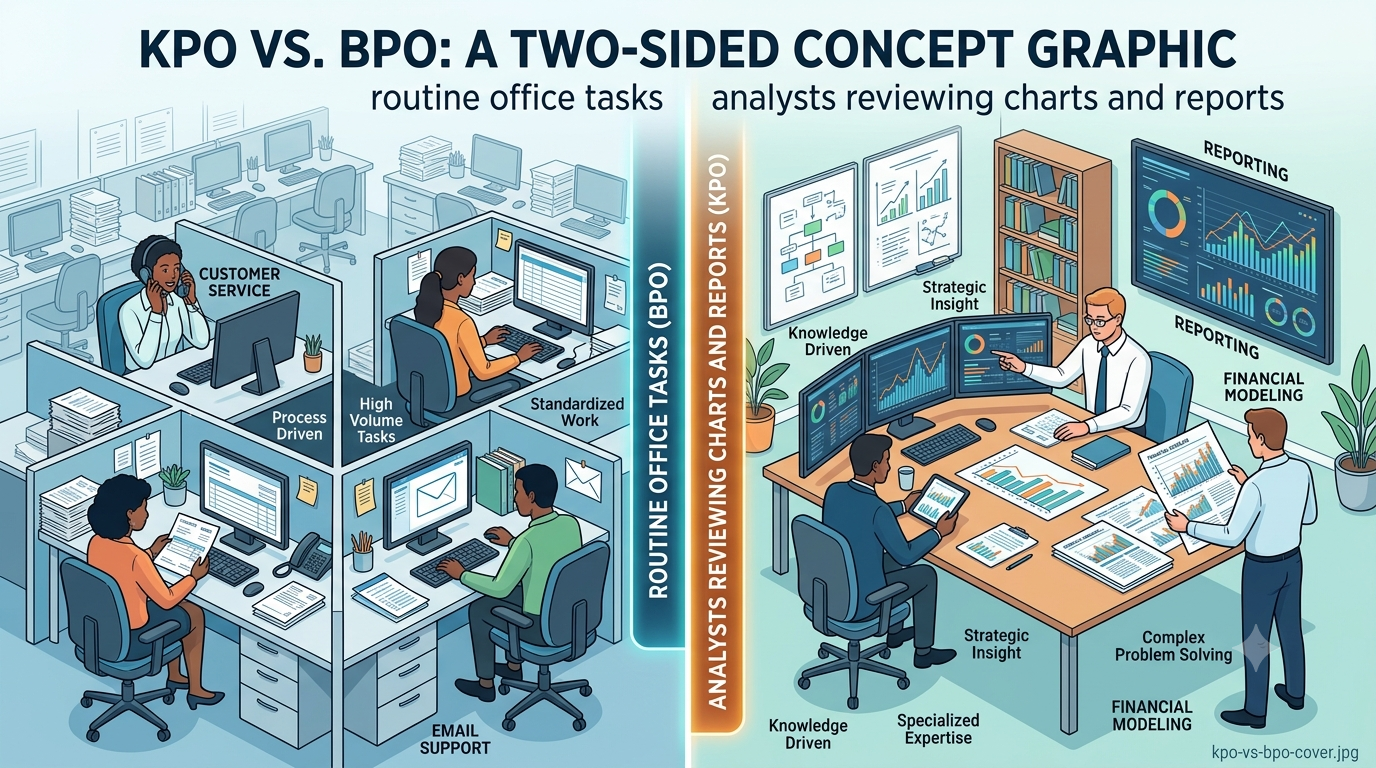
BPO stands for business process outsourcing. It covers routine, repeatable tasks that follow clear rules. Common examples are customer support, data entry, invoice processing, payroll processing and general back-office work. The aim is to do the work efficiently, accurately and at a lower cost.
What is KPO?
KPO stands for knowledge process outsourcing. It covers work that needs specialist knowledge, analysis and judgment. Examples include financial analysis, market research, business valuation, forecasting, legal and compliance research, and data analytics. The aim is better decisions, not only faster processing.
KPO vs BPO: the main differences
Type of work: BPO handles routine processes; KPO handles analysis and expert tasks.
Skills needed: BPO needs process discipline; KPO needs professional qualifications and domain experience.
Decision making: BPO follows set instructions; KPO involves judgment and recommendations.
Cost: BPO is usually cheaper per task; KPO costs more because the skills are rarer.
Outcome: BPO gives efficiency; KPO gives insight.
Examples from accounting
In accounting, entering invoices, processing payroll and basic bookkeeping are usually BPO-style work. Preparing management reports (MIS), business valuation, financial forecasting and tax or compliance analysis are KPO-style work. Many accounting firms offer both, so you can start with routine tasks and add higher-level analysis as the business grows.
Which one does your business need?
If your team is buried in repetitive tasks, start with BPO.
If you need help with planning, reporting or decisions, look at KPO.
If you need both, choose a provider that covers both so the work stays consistent.
What to check before you outsource
Does the provider have real experience in your industry?
How do they protect your data and keep it confidential?
Are the deliverables, deadlines and reviews written in the agreement?
Who is your main contact, and how quickly do they respond?
Conclusion
BPO helps you do routine work efficiently, and KPO helps you make better decisions. Most growing businesses need a mix of both over time. To discuss which approach suits your company, contact the team at KStar Capitals.
Blog 4: Outsourcing for Small Business
Post title (H1): Benefits of Outsourcing for Small Business Owners
Search title (58 / 60): Benefits of Outsourcing for Small Business | KStar Capitals
Focus keyword: benefits of outsourcing for small business
Meta description (145 / 160): Discover the main benefits of outsourcing for small business: lower costs, expert skills, faster growth and more time to focus on your core work.
URL slug: /benefits-of-outsourcing
Summary: Shows how small businesses use outsourcing to cut fixed costs, reach expert skills and grow, with the tasks worth outsourcing first and the risks to manage.
Cover image: A small business owner at a desk on a video call with a remote team, with a laptop and notebook. File name: benefits-of-outsourcing-cover.jpg
Cover image alt text: Small business owner on a video call with an outsourced team from a home office
In-post image: Icon-style graphic listing common outsourced tasks: accounting, IT, marketing, support. File name: tasks-to-outsource.png
In-post image alt text: Icons showing common tasks small businesses outsource such as accounting, IT and marketing
Post content
Small business owners usually do everything themselves: sales, operations, hiring and paperwork. At some point, that stops working. Hiring full-time staff for every function is expensive, and doing it all yourself leaves little time to grow. The benefits of outsourcing for small business are clear: you get skilled people for specific tasks without the cost of building a large team.
1. Lower and more predictable costs
A full-time employee brings salary, visa, insurance, equipment and other costs, whether or not there is enough work. With outsourcing you usually pay a fixed monthly fee or a price per project, which makes budgeting easier.
2. Access to expert skills
A small company rarely can afford a finance specialist, a developer, a designer and a marketer all at once. Outsourcing lets you use their skills when you need them, at a level you could not otherwise reach.
3. More time for your core work
When bookkeeping, website updates or customer follow-ups are handled by someone else, you can focus on selling, serving customers and planning the next step.
4. Flexibility to scale
If business grows, you can increase the work you outsource. If things slow down, you can reduce it, without hiring or letting people go.
5. Less dependence on one person
When a single employee handles a task, their leave or resignation can stall the business. An outsourced team spreads the work across several people.
What should you outsource first?
Accounting, bookkeeping and VAT support
Payroll processing
Website and app development
Marketing and social media
Customer support and administrative tasks
Start with tasks that are routine, time-consuming or outside your expertise. Keep control of strategy and customer relationships.
Risks and how to manage them
Quality: agree on deliverables and deadlines in writing, and start with a small trial.
Data security: share only what is needed, use access controls and sign a confidentiality agreement.
Communication: set a regular schedule for updates and a clear contact person.
Hidden costs: ask what is included in the fee and what is charged extra.
How to start outsourcing
List the tasks that take most of your time.
Choose one task to outsource first.
Compare two or three providers and check their references.
Begin with a short trial period.
Review the results and add more tasks if it works.
Conclusion
Outsourcing lets a small business act bigger than it is, with expert help, controlled costs and more time to grow. To find out which tasks suit outsourcing in your business, speak with KStar Capitals for a no-obligation conversation.