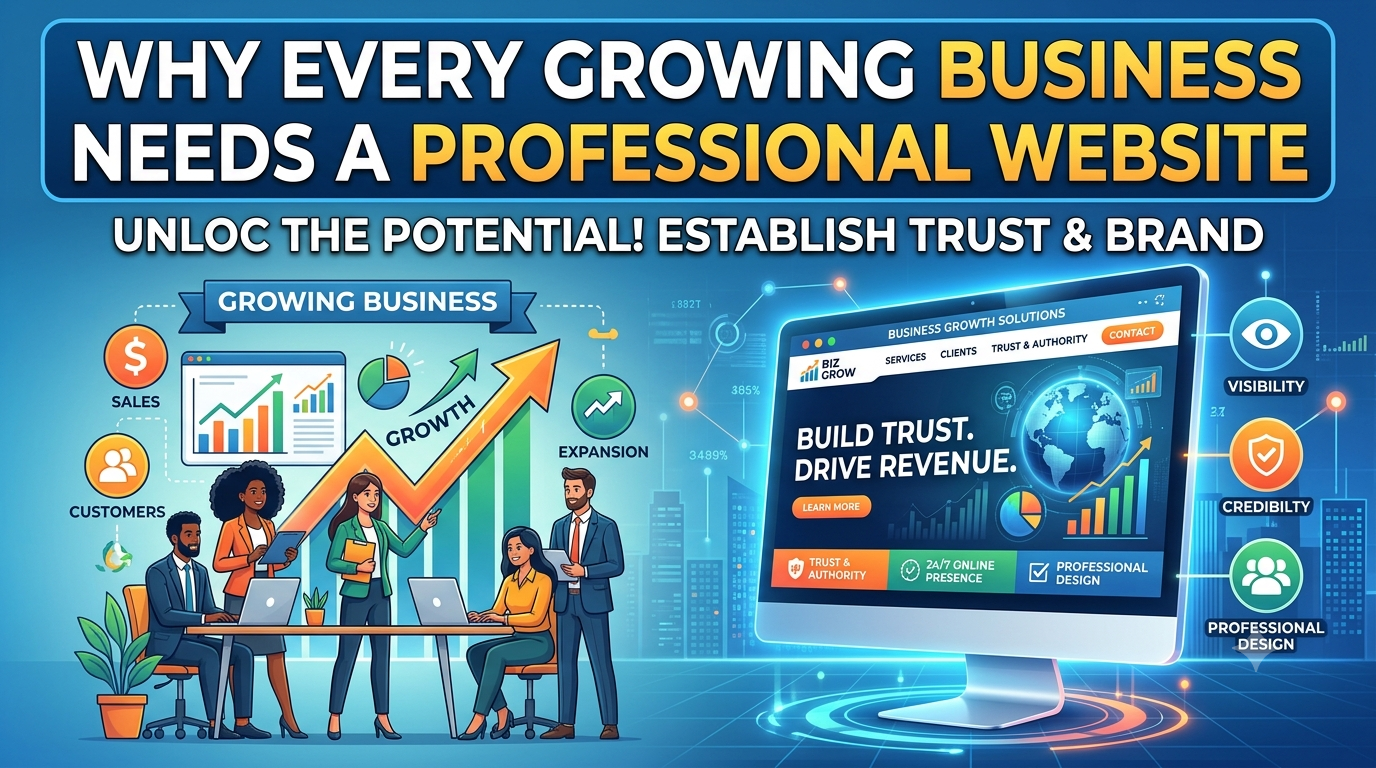
In today's competitive digital environment, having a strong online presence is essential for businesses that want to grow, reach new customers, and build lasting relationships. Whether you operate a startup, a small business, a service-based company, or an established enterprise, a professional website can play an important role in your long-term success.
Customers increasingly search online before choosing a company, comparing services, or making purchasing decisions. Without a website, potential customers may find it difficult to understand what your business offers, evaluate your credibility, or contact your team.
A professional website for business is more than an online brochure. It can help you showcase your services, generate enquiries, communicate with customers, and support your overall digital strategy.
In this article, we explore why every growing business needs a professional website, the benefits it offers, and how the right digital solutions can help businesses build a stronger online presence.
1. Build Credibility and Trust With Potential Customers
First impressions matter in business. When potential customers discover your company online, they often look for information that helps them decide whether your business is trustworthy and relevant to their needs.
A well-designed website provides a central place to introduce your company, explain your services, display your work, and share your contact information.
For example, imagine a business that provides accounting services to small companies. A professional website can explain its bookkeeping, financial reporting, and accounting support services, helping visitors understand what the business offers before making an enquiry.
Similarly, a software development company can use its website to present its technology services, development process, and project examples.
A professional website should include:
Clear information about your business and services
Professional design and easy navigation
Accurate contact details and enquiry options
Relevant project examples or portfolio content
Secure browsing through HTTPS
Consistent branding and helpful information
These elements help visitors understand your business and make informed decisions.
2. Reach More Customers in India and International Markets
One of the biggest advantages of website development is the opportunity to reach customers beyond your immediate geographical area.
A physical office or local network may limit how many potential customers discover your business. A website creates an online presence that people can access from different locations, subject to your service availability and business requirements.
For Indian businesses, this can mean attracting customers from other states. For companies targeting international markets, a website can introduce their services to potential clients in countries such as the United States, the United Kingdom, Australia, and the United Arab Emirates.
Consider a business offering back-office support, data management, or virtual assistance. With dedicated service pages, relevant content, and clear enquiry options, the company can explain how its services may support businesses in different markets.
To make your website more effective for international audiences, consider:
Using clear, professional English
Explaining your services and ideal client types
Displaying pricing or service packages when appropriate
Providing convenient contact and enquiry options
Creating content relevant to the markets you serve
Clearly communicating your working arrangements and service availability
A website does not guarantee international clients, but it gives your business a platform to present its capabilities and attract relevant enquiries.
3. Generate Business Leads Around the Clock
Traditional marketing often depends on direct conversations, networking events, referrals, or sales calls. These methods remain valuable, but a website can provide an additional channel for generating enquiries.
A website allows potential customers to learn about your services and submit an enquiry even when your team is unavailable.
For example, a company looking for a website redesign may visit your website outside normal business hours. If your website includes a dedicated development page, examples of relevant work, and a contact form, the visitor can learn about your offering and contact your team at a convenient time.
To make your website more effective at generating leads, include:
Clear calls to action, such as "Request a Quote" or "Discuss Your Project"
Contact forms with relevant fields
Dedicated pages for individual services
Case studies or portfolio examples, where available
Frequently asked questions
Links to your professional social media profiles
Your website should guide visitors toward a clear next step rather than simply presenting information.
4. Improve Your Visibility on Google Through SEO
Search engine optimisation (SEO) helps businesses improve their visibility in relevant search results. A well-structured website provides a foundation for implementing SEO strategies and attracting people who are actively looking for particular products or services.
For example, a business offering custom website development may create useful content around website design, e-commerce development, mobile-friendly websites, and website maintenance.
When these pages answer genuine customer questions and follow sound SEO practices, they may become discoverable through relevant searches.
Important website SEO practices include:
Keyword research: Identify the phrases your potential customers use when searching for your services.
Useful content: Publish informative service pages, articles, and guides that answer real customer questions.
Technical SEO: Ensure search engines can access and understand your website, with appropriate indexing, site structure, and XML sitemaps.
Mobile optimisation: Make pages easy to read and use on smartphones and tablets.
Page speed: Optimise images, code, and other resources to improve loading performance.
Internal linking: Connect related pages so visitors and search engines can discover relevant information.
SEO takes time and does not guarantee specific rankings. However, investing in a well-built website and useful content can support sustainable organic visibility.
5. Deliver a Better Customer Experience
A professional website should make it easy for visitors to find information and complete common tasks.
Confusing navigation, outdated information, slow pages, and unclear service descriptions can discourage potential customers from taking the next step.
A user-friendly website, on the other hand, helps visitors understand your offerings and find the information they need.
For a service-based company, a good customer experience might include separate pages for each service, an easy-to-find contact form, and clear explanations of the enquiry process.
For an e-commerce business, it might involve organised product categories, search and filtering options, secure checkout, and clear delivery information.
A good website experience should focus on:
Simple and consistent navigation
Readable text and accessible design
Responsive layouts for different screen sizes
Clear buttons and calls to action
Relevant, up-to-date information
Convenient ways to contact the business
The goal is to reduce friction and help visitors move naturally from discovering your business to considering your services.
6. Support Business Operations Through Digital Solutions
As businesses grow, managing daily operations can become more complex. A website can serve as the starting point for a broader digital system that supports business processes and customer interactions.
Depending on your requirements, your website can integrate with customer relationship management (CRM) systems, enquiry management tools, booking platforms, payment gateways, and other business applications.
For example, a consulting firm could use a website enquiry form connected to a CRM system to organise incoming leads. An online retailer could connect its website to inventory and order management tools. A service company could provide customers with an online booking or request-submission system.
Businesses with more specialised needs may benefit from custom website development or web application development.
Possible solutions include:
Customer portals and account dashboards
Online booking and appointment systems
E-commerce platforms
Workflow automation
CRM and third-party API integrations
Custom business applications
The right solution depends on your business model, budget, security requirements, and existing systems. Starting with clear business objectives helps avoid investing in features that do not provide meaningful value.
7. Connect Your Website With BPO, KPO, and Accounting Services
A website can also support the operational side of your business by connecting customers with the services and teams that help keep daily activities organised.
For example, a growing company may need a new website while also requiring assistance with data entry, customer support, back-office operations, market research, or bookkeeping.
Instead of treating these needs as unrelated challenges, businesses can develop a coordinated approach to technology and business support.
Here is how these services can work together:
Web development: Build a professional website that presents your business and services.
App development: Create applications or digital tools for specific customer and operational requirements.
BPO services: Support activities such as data processing, back-office operations, and customer service.
KPO services: Assist with research, information analysis, and other knowledge-intensive business activities, depending on the required expertise.
Accounting and digital accounts: Support bookkeeping, financial data processing, and accounting workflows according to the business's requirements.
For instance, an expanding online business might need an e-commerce website, organised product data, customer support processes, and accounting assistance. Coordinating these requirements can help the business establish a more organised operating model.
KStar Global Solutions brings these service areas together within its broader digital, technology, and business support offering. Businesses can explore the services relevant to their requirements and discuss an appropriate approach with the team.
8. Stay Competitive as Customer Expectations Evolve
Customer expectations change as digital technology becomes a more integral part of everyday business.
People often expect to find company information online, browse services on their phones, submit enquiries digitally, and receive timely responses.
A business without an effective online presence may miss opportunities to engage with customers who prefer these channels.
However, simply having a website is not enough. Your online presence should reflect your current services, business objectives, and customer expectations.
Regular website improvements may include updating service information, improving mobile usability, publishing helpful content, strengthening security, and reviewing website performance.
You can also use analytics tools to understand which pages visitors view, how they arrive at your website, and where they leave. These insights can help you identify areas for improvement.
A website should evolve alongside your business rather than remain a one-time project that is never reviewed.
9. How to Choose the Right Website Development Approach
Every business has different requirements, so the best website solution depends on your goals, audience, and available resources.
Before starting a website project, consider the following questions:
What is the main purpose of your website?
Decide whether you primarily need to generate leads, showcase services, sell products, accept bookings, or provide digital tools.
Who is your target audience?
Consider their location, language, expectations, and preferred devices.
What features do you actually need?
A service business may need enquiry forms and service pages, while an e-commerce business may require product management, payment processing, and order tracking.
Can the website grow with your business?
Choose a suitable technical approach that allows for future content, integrations, or functionality without unnecessary complexity.
How will the website be maintained?
Plan for security updates, backups, performance monitoring, content updates, and ongoing improvements.
Professional website development should balance appearance, functionality, usability, performance, and maintainability.
Working with a suitable development team can help translate your business requirements into a practical digital solution.
Frequently Asked Questions (FAQs)
1. Why does a small business need a professional website?
A professional website helps small businesses establish an online presence, explain their services, build credibility, and provide a convenient way for potential customers to contact them.
2. How much does business website development cost?
The cost depends on the website's complexity, design requirements, number of pages, functionality, integrations, and ongoing maintenance needs. A simple business website generally requires a different investment from a custom web application or a full e-commerce platform. Request a project-specific quotation to understand the expected costs.
3. Can a website help generate international clients?
Yes. A website can make your services accessible to potential customers in different countries and provide information that helps them evaluate your business. Results depend on factors such as service relevance, SEO, marketing, competition, and the quality of your website.
4. How long does it take to develop a professional website?
The timeline varies according to project scope, design complexity, content readiness, integrations, testing, and client feedback. A basic website may take considerably less time than a complex custom platform. Your development team should establish a realistic timeline after reviewing the requirements.
5. Is SEO important for a business website?
Yes. SEO helps search engines understand your website and can improve its visibility for relevant searches. Effective SEO involves technical optimisation, useful content, appropriate keywords, and a good user experience. Results are not immediate or guaranteed.
6. Can my website integrate with business software and accounting systems?
Depending on the platform and available integrations, a website may connect with CRM systems, payment gateways, accounting software, inventory tools, and other applications. Integration feasibility depends on the specific software, permissions, APIs, and technical requirements.
7. Should I choose a website or a mobile app for my business?
A website is often a practical starting point for presenting services and reaching customers online. A mobile app may be useful when customers need frequent interactions, specialised functionality, or a dedicated mobile experience. Some businesses benefit from both.
Conclusion: Build a Stronger Digital Foundation for Your Business
A professional website can help growing businesses establish credibility, reach wider audiences, improve customer engagement, and create new opportunities for enquiries.
When combined with a clear SEO strategy, a good user experience, and appropriate digital tools, your website can become an important part of your business development efforts.
As your business expands, you may also need complementary solutions such as web applications, workflow automation, BPO/KPO services, and accounting support. Planning these requirements together can help create a more connected and practical digital business environment.
At KStar Global Solutions, our services span web development, app development, and business support solutions, including relevant BPO/KPO and accounting services.
Ready to strengthen your business's digital presence?
Visit https://kstarcapitals.com/ to explore our offerings and get in touch with our team to discuss your website development or broader digital business requirements.
Let's explore a solution that aligns with your business goals and supports your next stage of growth.