AI Agents for Business Automation in 2026: A Practical Guide for Businesses
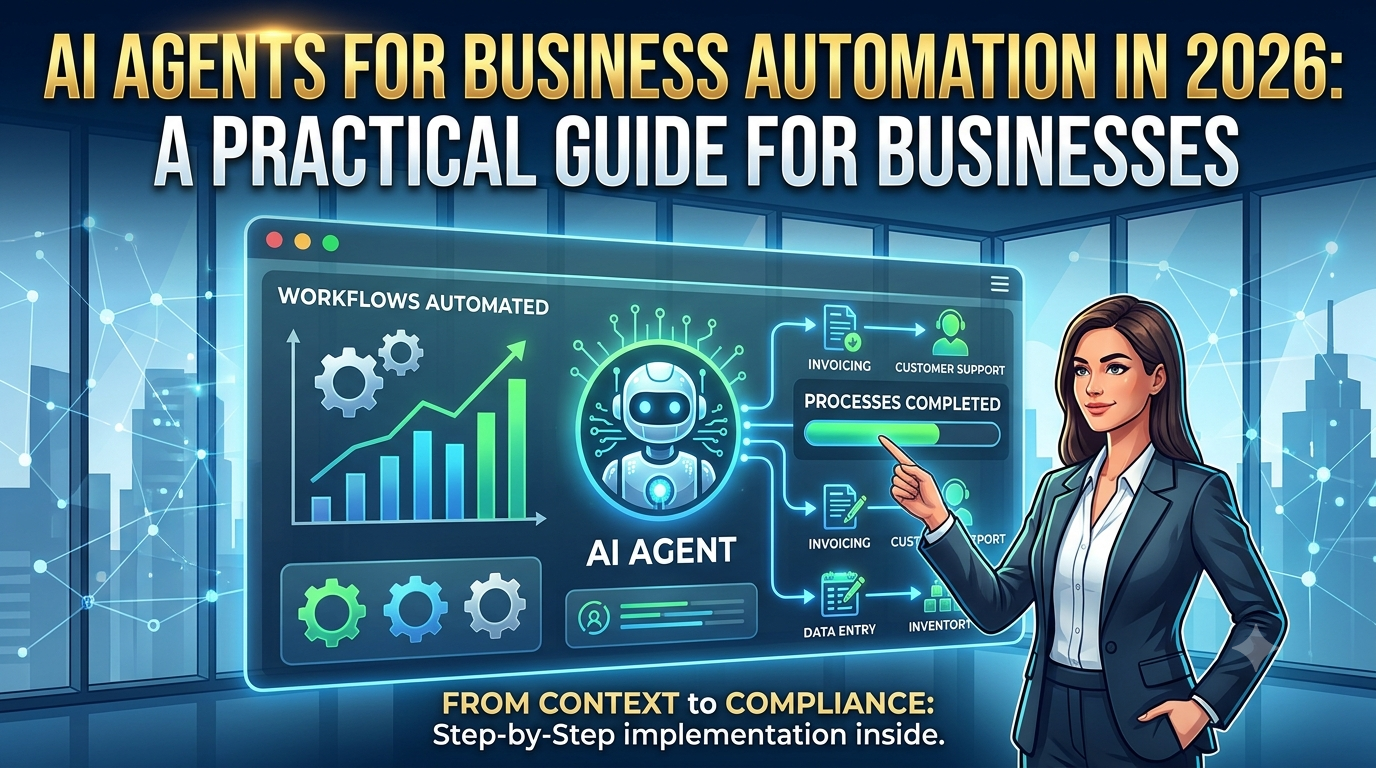
Businesses are increasingly exploring artificial intelligence to improve productivity, reduce repetitive work and deliver better customer experiences. While traditional automation follows predefined rules, AI agents can interpret information, respond to changing situations and perform sequences of tasks within defined permissions.
For businesses considering digital transformation, understanding AI agents for business automation is an important first step.
What Are AI Agents?
AI agents are software systems designed to work towards a defined goal. Depending on their design, they can analyse information, use connected tools, make recommendations and carry out approved actions.
For example, a customer enquiry agent could classify incoming messages, identify the relevant department, draft a response and create a follow-up task for an employee.
However, an AI agent is not automatically reliable or fully independent. Its performance depends on the quality of its instructions, connected data, permissions and human supervision.
How AI Agents Can Help Businesses
1. Automating customer enquiries
AI-powered systems can answer common questions, provide information about services and direct enquiries to the appropriate team. They can also help employees prepare responses to more complicated requests.
This can improve response consistency, provided the system has accurate information and a clear process for escalating uncertain cases.
2. Supporting sales and lead management
An AI agent can help organise incoming leads, summarise customer conversations, identify missing information and prepare follow-up reminders.
Sales staff can then spend more time speaking with potential customers instead of manually updating multiple systems.
3. Streamlining internal workflows
Businesses often rely on repetitive activities such as document classification, data entry, report preparation and task assignment.
With appropriate integrations, AI agents can assist with these processes while keeping employees involved in approvals and exceptions.
4. Improving access to business information
An AI-powered internal assistant can help employees search approved documents, retrieve relevant information and summarise lengthy records.
Access permissions are essential. Employees should only receive information they are authorised to view.
AI Agents vs Traditional Automation
Traditional automation works well when tasks follow predictable rules. For example, a system can automatically send an invoice reminder when a payment becomes overdue.
An AI agent may be more useful when a task requires interpreting an email, identifying the customer's request and deciding which approved workflow should follow.
Many businesses can benefit from combining both approaches instead of replacing every existing process with AI.
What Should Businesses Consider Before Implementing AI?
Before adopting AI agents, identify a specific business problem rather than starting with technology alone.
Define the objective: Decide which process needs improvement and how success will be measured.
Review the data: Ensure that information is accurate, relevant and appropriately protected.
Set permissions: Limit what the AI system can access and change.
Keep human oversight: Require approval for sensitive financial, legal or customer-facing actions.
Test before deployment: Check accuracy, unusual cases and failure handling in a controlled environment.
Monitor performance: Review errors, operating costs and user feedback regularly.
Security deserves particular attention as AI systems connect to business applications and sensitive data. Current cybersecurity guidance highlights the need for appropriate permissions, monitoring and governance.
World Economic Forum
+1
How KStar Capitals Can Support Your Digital Goals
KStar Capitals helps businesses explore digital solutions, including website and app development, UI/UX design and business support services.
Whether you are planning a new application or looking to improve an existing workflow, the first step is to identify the business requirement, assess the available data and choose a practical solution.
Not every process requires a sophisticated AI agent. In some cases, a simple integration or rule-based automation may deliver a better result.
Frequently Asked Questions
What is an AI agent in business?
An AI agent is a software system that can interpret information and perform defined tasks using connected tools and permissions.
Can AI agents automate repetitive business tasks?
Yes. They can assist with activities such as classifying enquiries, preparing summaries, organising information and coordinating workflows, subject to testing and oversight.
Are AI agents suitable for small businesses?
They can be useful for small businesses when the selected task is clearly defined, the cost is manageable and the expected benefit justifies implementation.
Do AI agents replace employees?
Not necessarily. They are often most useful when they handle repetitive work while employees retain responsibility for judgement, customer relationships and important decisions.
Ready to Explore AI for Your Business?
Contact KStar Capitals to discuss your digital requirements and explore practical ways to improve business workflows through technology.