Custom Software vs Ready-Made Software: Which Is Better for Your Business?
Choosing the right software can influence how efficiently a business operates. From managing customers and tracking orders to preparing reports and coordinating employees, digital tools can support many everyday activities.
Businesses generally have two options: purchase ready-made software or invest in a custom solution designed around their specific requirements.
Neither option is automatically better. The right choice depends on your workflows, budget, technical requirements and plans for growth.
What Is Ready-Made Software?
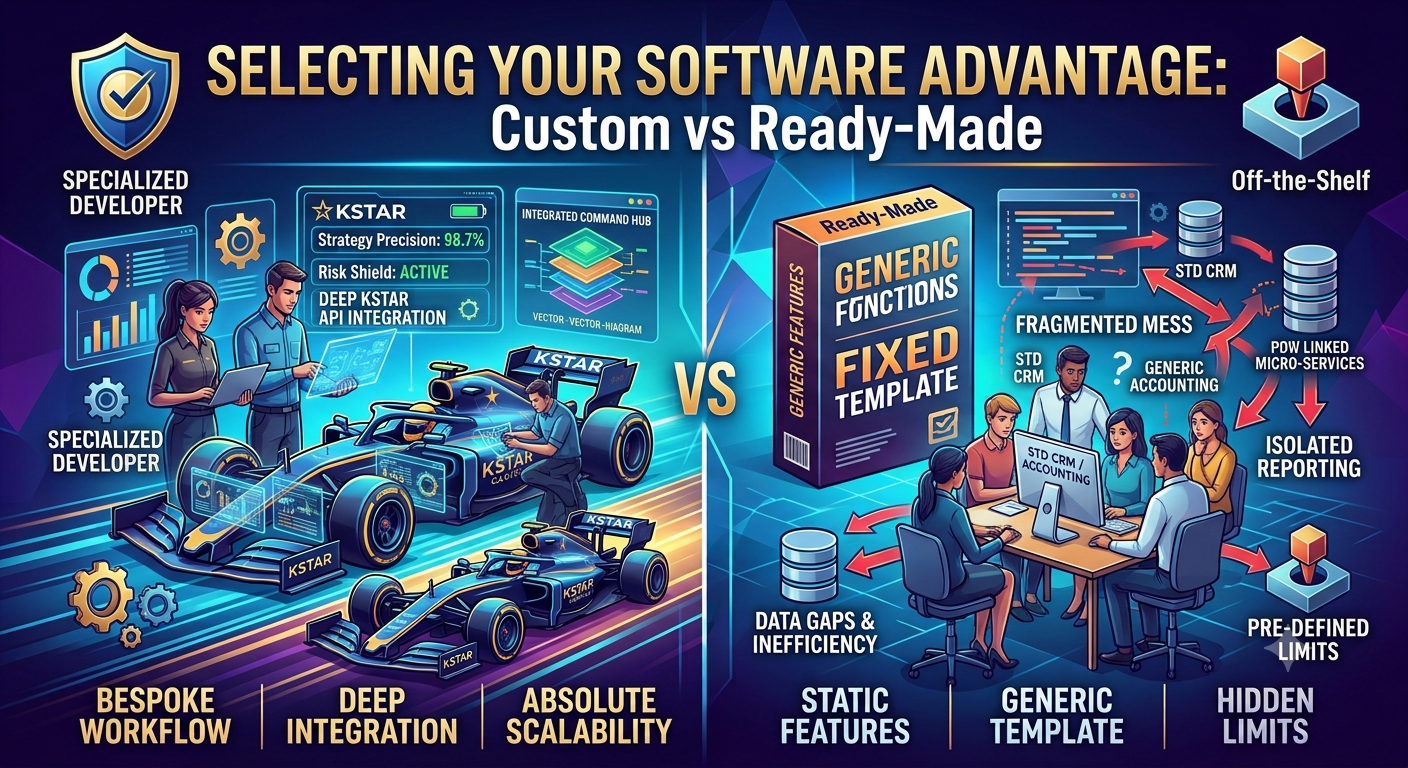
Ready-made software is developed for a broad group of users. Businesses can usually subscribe to it or purchase a licence and begin using its existing features.
Examples include standard accounting platforms, customer relationship management systems, project management applications and inventory management tools.
Benefits of ready-made software
Faster implementation: Most core features already exist.
Predictable pricing: Subscription or licence costs are often published in advance.
Existing support: Providers may offer documentation, updates and customer service.
Established functionality: Common business processes may already be supported.
However, ready-made software may not match every company's workflow. Some features may be unnecessary, while other requirements may need workarounds or paid integrations.
What Is Custom Software?
Custom software is designed and developed around the requirements of a particular business or user group.
A company might need a customer portal, a specialised booking system, a business reporting dashboard or an application that connects several existing platforms.
Custom development can provide greater control over features, workflows and user experience. It also requires planning, development, testing and ongoing maintenance.
Key Differences Between the Two Approaches
Factor
Ready-made software
Custom software
Initial setup
Usually quicker
Requires a development process
Features
Standardised
Designed around agreed requirements
Flexibility
Limited by the product
Can be tailored to the project
Initial investment
Often lower
Can be higher
Integrations
Depends on available connectors and APIs
Can be designed for specific integrations
Maintenance
Often handled partly by the vendor
Requires an agreed maintenance plan
Ownership and control
Governed by licence terms
Depends on the contract and intellectual property terms
When Should a Business Choose Ready-Made Software?
Ready-made software is often suitable when standard features meet most business requirements.
For example, a small business that needs routine invoicing, expense tracking and standard financial reports may find an existing accounting platform more practical than developing a new one.
Similarly, a company that needs basic appointment scheduling may be able to use an existing booking service without commissioning a custom application.
Before choosing a product, check its subscription costs, user limits, integrations, data export options and ability to support future requirements.
When Does Custom Software Make Sense?
Custom software may be worth considering when existing tools cannot support important business processes efficiently.
Imagine a company that manages enquiries, quotations, project progress, supplier payments and customer reporting across several disconnected spreadsheets.
A custom platform could bring selected workflows into one interface, provided the expected benefits justify the development and maintenance costs.
Custom development may also help businesses that require specialised customer portals, unique approval processes or integrations unavailable in standard products.
However, custom software should not be developed simply because it sounds more advanced. The business problem must justify the investment.
How to Calculate the Total Cost
The initial purchase price is only one part of software cost.
Consider the following:
Licence and subscription fees.
Implementation and configuration.
Data migration and employee training.
Third-party integrations.
Ongoing support and maintenance.
Future upgrades and changes.
For custom development, include discovery, design, development, testing, hosting, security updates and post-launch support.
A useful decision method is to estimate the total cost over a three-to-five-year period and compare it with measurable benefits, such as reduced manual work, fewer errors or improved customer service.
Can Businesses Combine Both Approaches?
Yes. A hybrid strategy is often practical.
A company might use ready-made accounting software while developing a custom customer portal that connects to it through an approved API.
This approach can preserve established functionality while addressing specific operational gaps.
How KStar Capitals Can Help
KStar Capitals offers digital business solutions, including website and app development and UI/UX design. We can help businesses evaluate their requirements and explore suitable approaches to new digital projects.
The starting point is to identify the actual problem, review existing tools and establish the features needed before deciding whether custom development is justified.
Frequently Asked Questions
Is custom software always more expensive?
Custom software often requires a larger initial investment, but the total cost depends on complexity, maintenance and the alternatives available.
Can custom software integrate with existing systems?
Yes, where the existing systems provide suitable APIs, connectors or other supported integration methods.
Is ready-made software better for startups?
It can be a practical starting point because it may offer useful features without the cost and time involved in custom development.
Can a business start with ready-made software and move to custom software later?
Yes. Businesses can transition as their needs change, provided they plan data migration, integrations and continuity carefully.
Looking for the Right Digital Solution?
Contact KStar Capitals to discuss your business requirements and explore whether a custom website, application or integration could help.